Recent Gallery


Tampilkan postingan dengan label Monuments. Tampilkan semua postingan

The Lion Monument in Lucerne — Switzerland

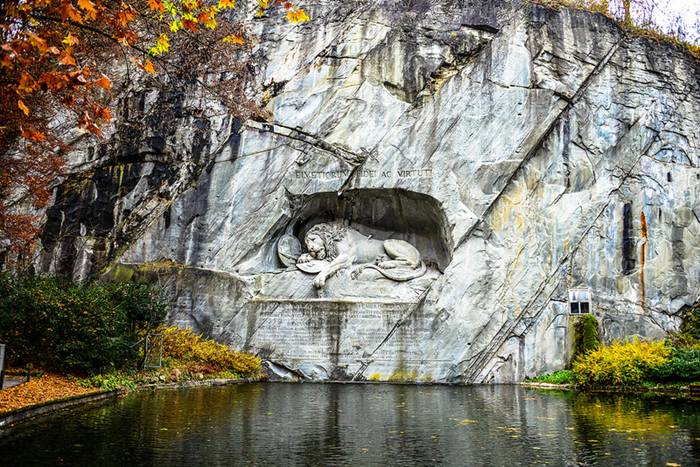
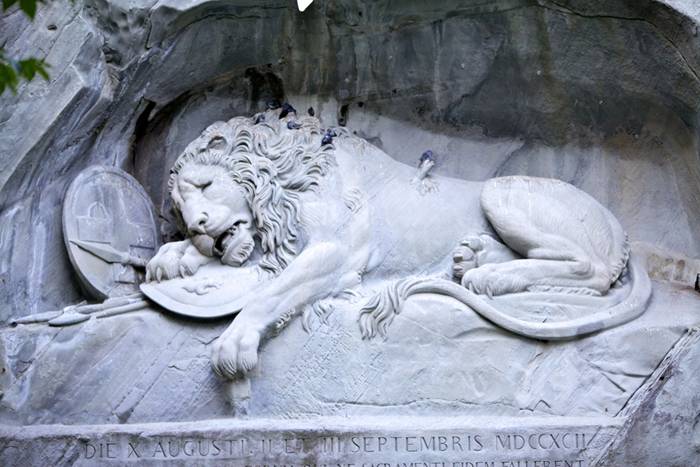
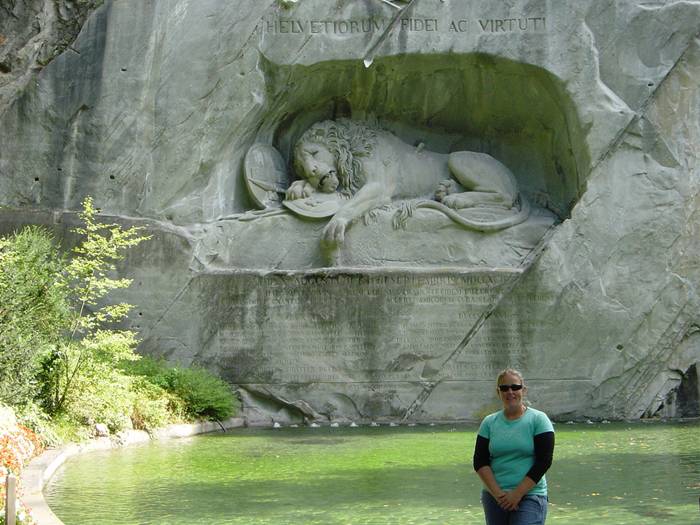
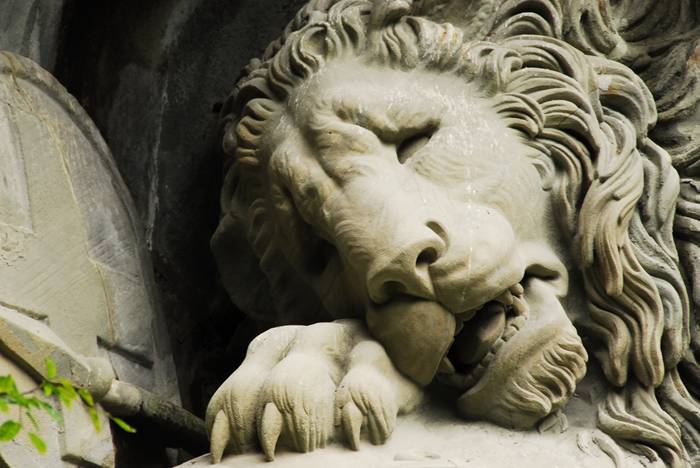
The Lion Monument, or the Lion of Lucerne, is a sculpture in Lucerne, Switzerland, designed by Bertel Thorvaldsen and hewn in 1820–21 by Lukas Ahorn. It commemorates the Swiss Guards who were massacred in 1792 during the French Revolution, when revolutionaries stormed the Tuileries Palace in Paris, France. Mark Twain praised the sculpture of a mortally-wounded lion as "the most mournful and moving piece of stone in the world."

From the early 17th century, a regiment of Swiss mercenaries had served as part of the Royal Household of France. On 6 October 1789, King Louis XVI had been forced to move with his family from the Palace of Versailles to the Tuileries Palace in Paris. In June 1791 he tried to flee abroad. In the 1792 10th of August Insurrection, revolutionaries stormed the palace. Fighting broke out spontaneously after the Royal Family had been escorted from the Tuileries to take refuge with the Legislative Assembly. The Swiss Guards ran low on ammunition and were overwhelmed by superior numbers. A note written by the King has survived, ordering the Swiss to retire and return to their barracks, but this was only acted on after their position had become untenable.
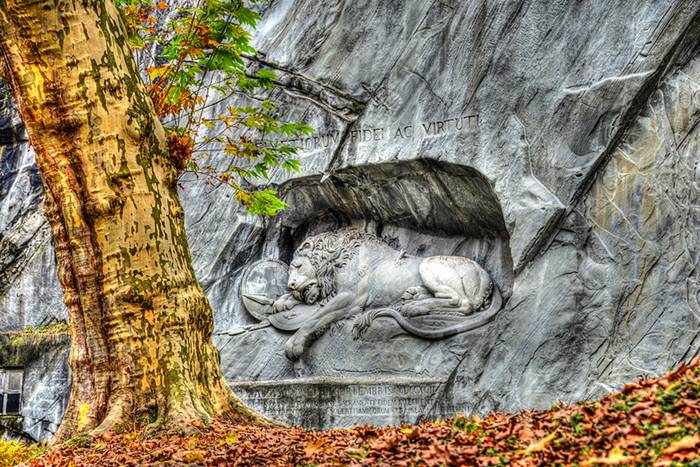
The Lion Monument, or the Lion of Lucerne, is a sculpture in Lucerne, Switzerland, designed by Bertel Thorvaldsen and hewn in 1820–21 by Lukas Ahorn. It commemorates the Swiss Guards who were massacred in 1792 during the French Revolution, when revolutionaries stormed the Tuileries Palace in Paris, France. Mark Twain praised the sculpture of a mortally-wounded lion as "the most mournful and moving piece of stone in the world."

Of the Swiss Guards defending the Tuileries, more than six hundred were killed during the fighting or massacred after surrender. An estimated two hundred more died in prison of their wounds or were killed during the September Massacres that followed. Apart from about a hundred Swiss who escaped from the Tuileries, the only survivors of the regiment were a 300 strong detachment which had been sent to Normandy a few days before August 10. The Swiss officers were mostly amongst those massacred, although Major Karl Josef von Bachmann — in command at the Tuileries —was formally tried and guillotined in September, still wearing his red uniform coat. Two surviving Swiss officers achieved senior rank under Napoleon.
The Lion Monument, or the Lion of Lucerne, is a sculpture in Lucerne, Switzerland, designed by Bertel Thorvaldsen and hewn in 1820–21 by Lukas Ahorn. It commemorates the Swiss Guards who were massacred in 1792 during the French Revolution, when revolutionaries stormed the Tuileries Palace in Paris, France. Mark Twain praised the sculpture of a mortally-wounded lion as "the most mournful and moving piece of stone in the world."
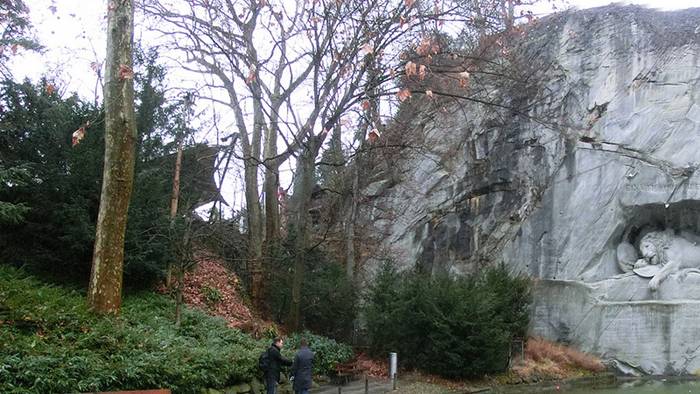
Memorial — The initiative to create the monument was taken by Karl Pfyffer von Altishofen, an officer of the Guards who had been on leave in Lucerne at that time of the fight. He began collecting money in 1818. The monument was designed by Danish sculptor Bertel Thorvaldsen, and finally hewn in 1820–21 by Lukas Ahorn, in a former sandstone quarry near Lucerne. Carved into the cliff face, the monument measures a staggering ten meters in length and six meters in height.

The monument is dedicated Helvetiorum Fidei ac Virtuti ("To the loyalty and bravery of the Swiss"). The dying lion is portrayed impaled by a spear, covering a shield bearing the fleur-de-lis of the French monarchy; beside him is another shield bearing the coat of arms of Switzerland. The inscription below the sculpture lists the names of the officers and gives the approximate numbers of soldiers who died (DCCLX = 760), and survived (CCCL = 350).

The monument is described by Thomas Carlyle in The French Revolution: A History. The pose of the lion was copied in 1894 by Thomas M. Brady (1849–1907) for his Lion of Atlanta in the Oakland Cemetery in Atlanta, Georgia.
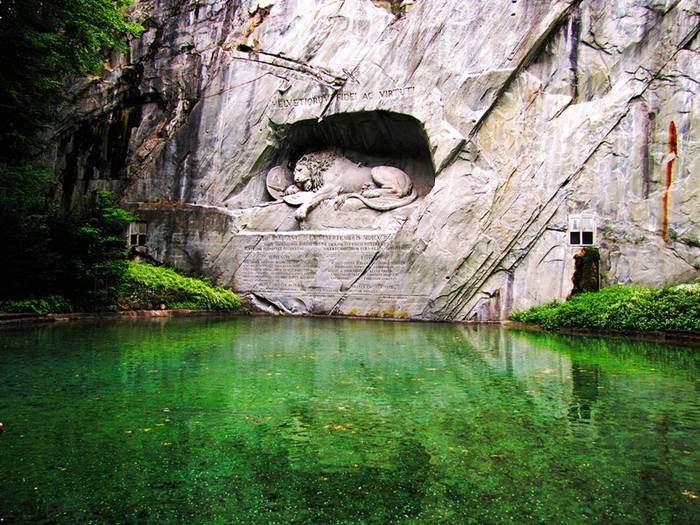
The Lion Monument, or the Lion of Lucerne, is a sculpture in Lucerne, Switzerland, designed by Bertel Thorvaldsen and hewn in 1820–21 by Lukas Ahorn. It commemorates the Swiss Guards who were massacred in 1792 during the French Revolution, when revolutionaries stormed the Tuileries Palace in Paris, France. Mark Twain praised the sculpture of a mortally-wounded lion as "the most mournful and moving piece of stone in the world."The Lion Monument, or the Lion of Lucerne, is a sculpture in Lucerne, Switzerland, designed by Bertel Thorvaldsen and hewn in 1820–21 by Lukas Ahorn. It commemorates the Swiss Guards who were massacred in 1792 during the French Revolution, when revolutionaries stormed the Tuileries Palace in Paris, France. Mark Twain praised the sculpture of a mortally-wounded lion as "the most mournful and moving piece of stone in the world."The Lion Monument, or the Lion of Lucerne, is a sculpture in Lucerne, Switzerland, designed by Bertel Thorvaldsen and hewn in 1820–21 by Lukas Ahorn. It commemorates the Swiss Guards who were massacred in 1792 during the French Revolution, when revolutionaries stormed the Tuileries Palace in Paris, France. Mark Twain praised the sculpture of a mortally-wounded lion as "the most mournful and moving piece of stone in the world."The Lion Monument, or the Lion of Lucerne, is a sculpture in Lucerne, Switzerland, designed by Bertel Thorvaldsen and hewn in 1820–21 by Lukas Ahorn. It commemorates the Swiss Guards who were massacred in 1792 during the French Revolution, when revolutionaries stormed the Tuileries Palace in Paris, France. Mark Twain praised the sculpture of a mortally-wounded lion as "the most mournful and moving piece of stone in the world."The Lion Monument, or the Lion of Lucerne, is a sculpture in Lucerne, Switzerland, designed by Bertel Thorvaldsen and hewn in 1820–21 by Lukas Ahorn. It commemorates the Swiss Guards who were massacred in 1792 during the French Revolution, when revolutionaries stormed the Tuileries Palace in Paris, France. Mark Twain praised the sculpture of a mortally-wounded lion as "the most mournful and moving piece of stone in the world."The Lion Monument, or the Lion of Lucerne, is a sculpture in Lucerne, Switzerland, designed by Bertel Thorvaldsen and hewn in 1820–21 by Lukas Ahorn. It commemorates the Swiss Guards who were massacred in 1792 during the French Revolution, when revolutionaries stormed the Tuileries Palace in Paris, France. Mark Twain praised the sculpture of a mortally-wounded lion as "the most mournful and moving piece of stone in the world."The Lion Monument, or the Lion of Lucerne, is a sculpture in Lucerne, Switzerland, designed by Bertel Thorvaldsen and hewn in 1820–21 by Lukas Ahorn. It commemorates the Swiss Guards who were massacred in 1792 during the French Revolution, when revolutionaries stormed the Tuileries Palace in Paris, France. Mark Twain praised the sculpture of a mortally-wounded lion as "the most mournful and moving piece of stone in the world."The Lion Monument, or the Lion of Lucerne, is a sculpture in Lucerne, Switzerland, designed by Bertel Thorvaldsen and hewn in 1820–21 by Lukas Ahorn. It commemorates the Swiss Guards who were massacred in 1792 during the French Revolution, when revolutionaries stormed the Tuileries Palace in Paris, France. Mark Twain praised the sculpture of a mortally-wounded lion as "the most mournful and moving piece of stone in the world."

The Grave of 1177 Soldiers


Pearl Harbor (see more photos) on Oahu, Hawaii, is a significant historical location. It was here where the Japanese attacked the U.S. Pacific fleet on December 7, 1941, which led the United States to enter World War II. Today, Pearl Harbor (including the Arizona Memorial) is the most-visited destination on Oahu, with more than 1.5 million visitors per year. 
A visit of Pearl Harbor and the Arizona Memorial is a solemn and a learning experience in the same time. At the Arizona Memorial, (a platform that was built atop the sunken battleship USS Arizona), you will be literally on top of the grave of 1,177 soldiers who perished aboard. From the platform you can see the battleship, which lies six feet below the water's surface. After more than 67 years after the attack, oil is still leaking out of the battleship, also called the “Black Tears of the Arizona.” You’ll have to board a small Navy shuttle boat to reach the Memorial.

The best time to visit Pearl Harbor is early in the morning, when it’s not too crowded yet. You can either drive yourself, take a city bus or do the tour with one of the local tour companies (which also includes a guide). Once you arrive, you can stroll through the Pearl Harbor museum, featuring World War II memorabilia and photos of the attack. After that, watch a 23-minute documentary film featuring actual footage of the attack. After the video you’ll board the Navy shuttle boat that will take you to the Arizona Memorial.

Back on land, you can visit the battleship USS Missouri, also known as the “Mighty Mo.” This battleship, which is still intact, is the site of Japan’s formal surrender, ending World War II for the United States.

There are a few other things to do at Pearl Harbor if you still have time. A complete tour would also include a visit to the Pacific Aviation Museum and the Bowfin submarine. So you can definitely make an entire day out of your visit to Pearl Harbor.


Pearl Harbor Hours

7:30 am - 5 pm daily, except Thanksgiving, Christmas and New Years Day.

Tours to the USS Arizona Memorial begin every 15 minutes, with the last program starting at 3 pm. Visitors should plan to arrive by 1 pm. to ensure space availability. The entire program takes about one hour and 15 minutes. Tours are given on a first-come, first-serve basis. No reservations are accepted.


Via — Link
 
Support : Venus Net | Pagak City
Copyright © 2013. teen pussy girl - All Rights Reserved
Template Created by Together Published by Venus Net
Proudly powered by Blogger