Recent Gallery


Tampilkan postingan dengan label Impossible Places. Tampilkan semua postingan

World's Hottest Inhabited Place — Dallol, Ethiopia

Dallol, EthiopiaWith an average daily temperature of 34.4 °C (93.9 °F), it should come as no surprise that these days the city little more than a ghost town.

Alberobello a Unique Italian Village


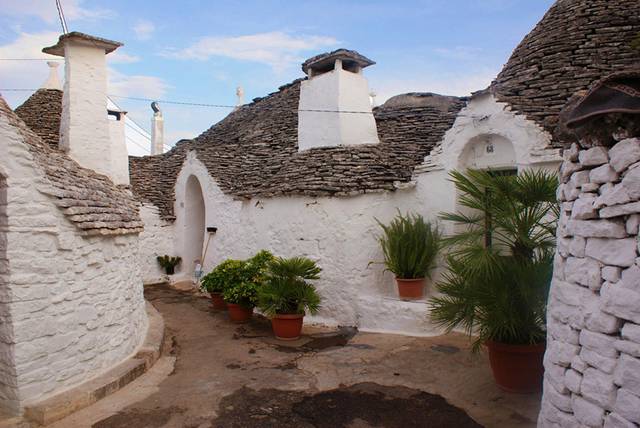
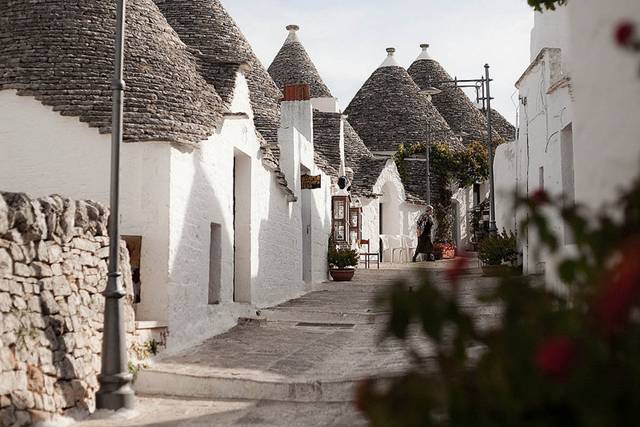
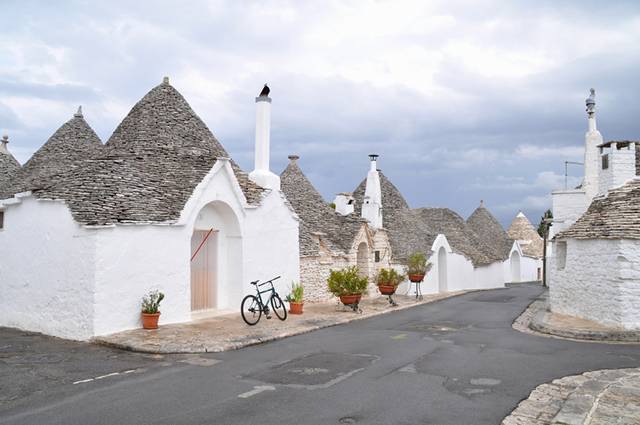
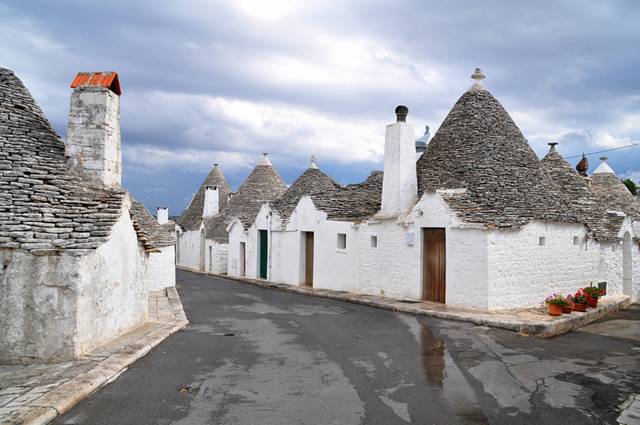
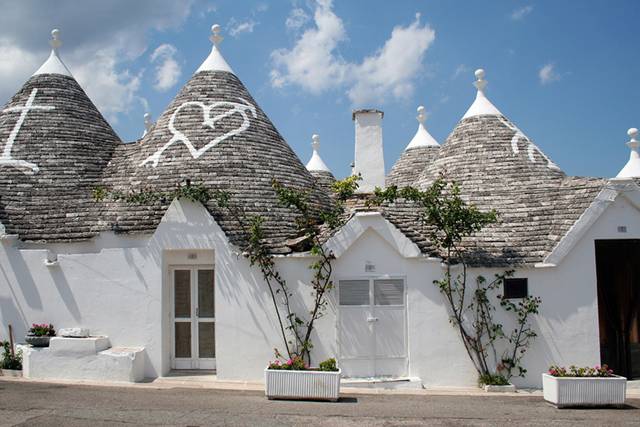
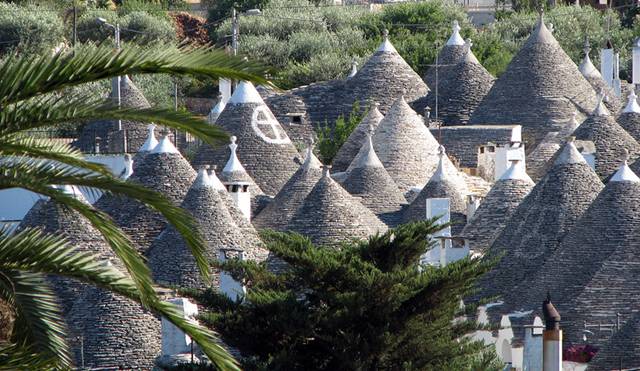
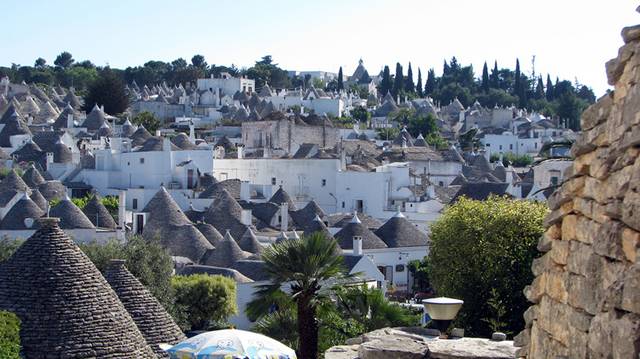
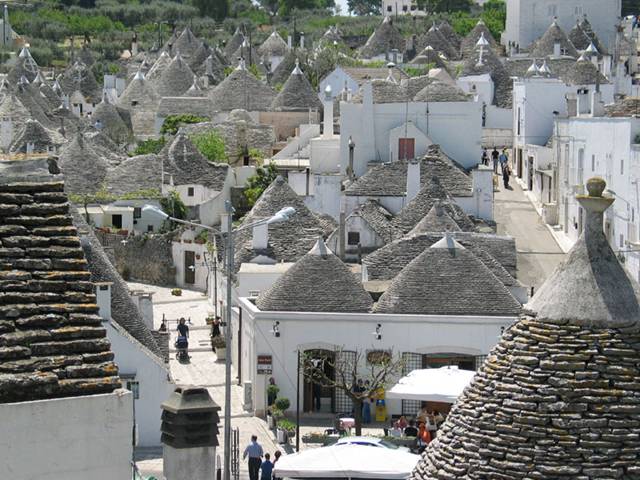
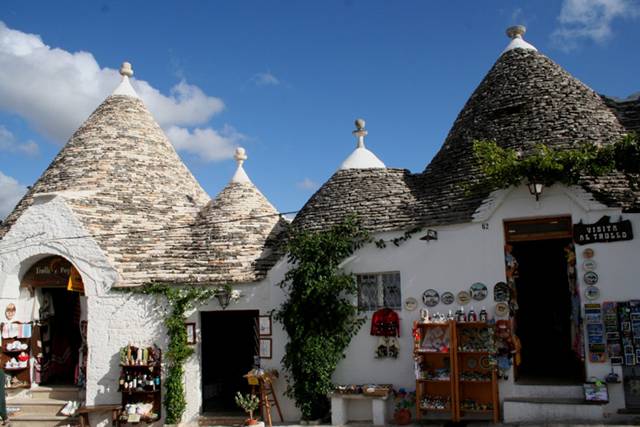
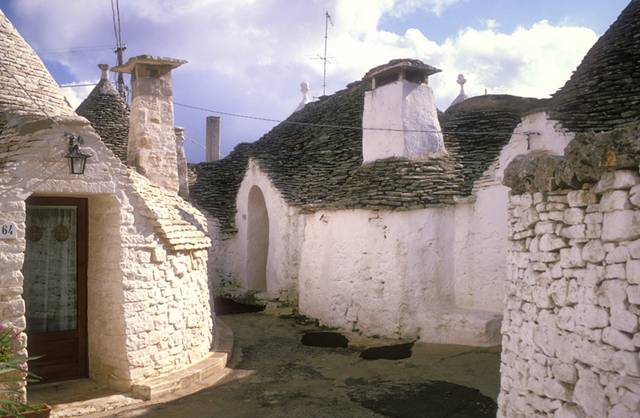
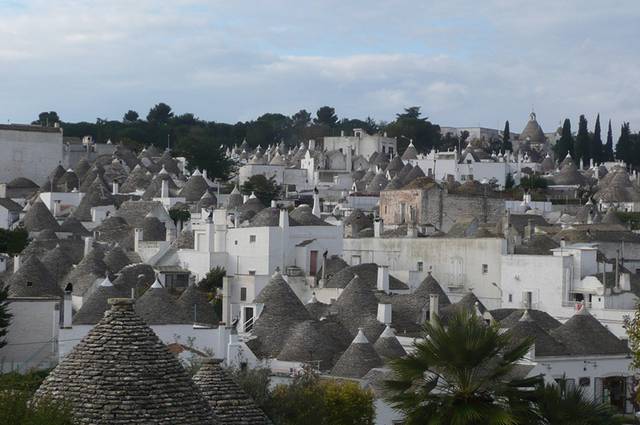
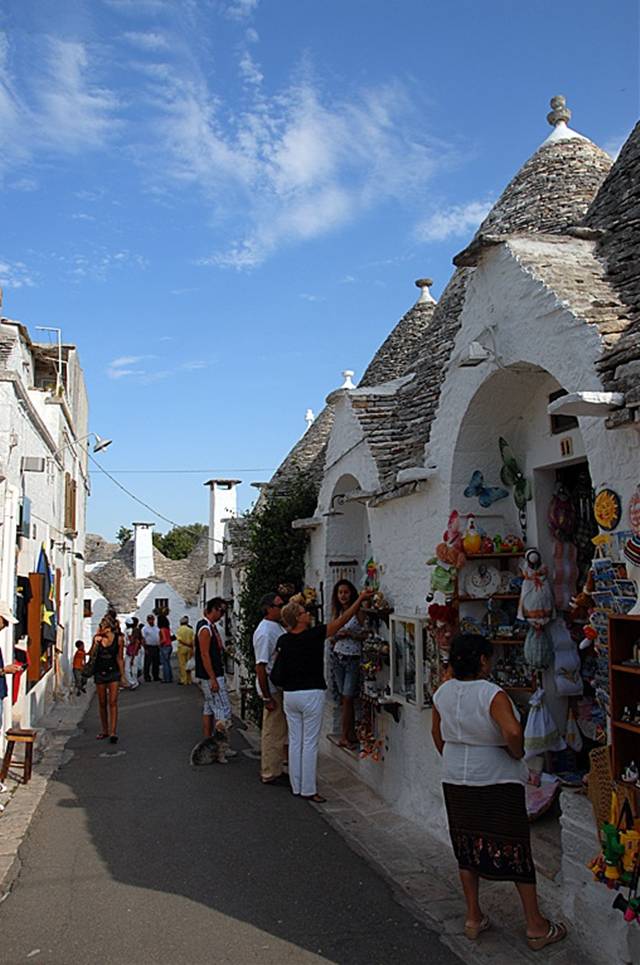
Alberobello, the city of drystone dwellings known as trulli , is an exceptional example of vernacular architecture. It is one of the best preserved and most homogeneous urban areas of this type in Europe. Its special features, and the fact that the buildings are still occupied, make it unique. It also represents a remarkable survival of prehistoric building techniques.  There was prehistoric settlement in the Itria and the tholos (dome-shaped tomb) tradition of building may have come to the region at this time. The present settlement dates from the mid-14th century, when what appears to have been an uninhabited area was granted to the first Count of Conversano by Robert d'Anjou, Prince of Taranto, in recognition of his service during the Crusades. He and his successors colonized the area by moving people from their other fiefs, allowing them to build cottages known as caselle.
However, recent research suggests that scattered rural settlements that began around AD 1000 gradually coalesced to form the village units of latter-day Aja Piccola and Monti. Tradition has it that drystone walling was imposed upon the new settlers so their houses could be quickly dismantled. This served two purposes: recalcitrant householders could be dispossessed easily and, later, it would be possible to avoid taxation on new settlements. In the latter case the buildings could be reconstructed equally rapidly. This is known to have occurred in 1644 to thwart tax inspectors sent by the King of Naples. However, historical and comparative analysis suggests that this technique was a minimal physical response to local conditions, later to be exploited for punitive purposes. 
Alberobello, the city of drystone dwellings known as trulli , is an exceptional example of vernacular architecture. It is one of the best preserved and most homogeneous urban areas of this type in Europe. Its special features, and the fact that the buildings are still occupied, make it unique. It also represents a remarkable survival of prehistoric building techniques.
By the mid-16th century the Monti area was already occupied by some 40 trulli , but it was in 1620 that the settlement began to expand, when Count Gian Girolamo Guercio ordered the construction of a bakery, a mill and an inn. By the end of the 18th century the community numbered over 3,500, and in 1797 they brought the feudal rule of the Acquaviva family to an end by obtaining the status of royal town from Ferdinand IV, King of Naples. The name of Alberobello was adopted, taken from the medieval Latin name of the region, siva arboris belli . From this time onwards the construction of new trulli quickly declined.
Alberobello, the city of drystone dwellings known as trulli , is an exceptional example of vernacular architecture. It is one of the best preserved and most homogeneous urban areas of this type in Europe. Its special features, and the fact that the buildings are still occupied, make it unique. It also represents a remarkable survival of prehistoric building techniques.
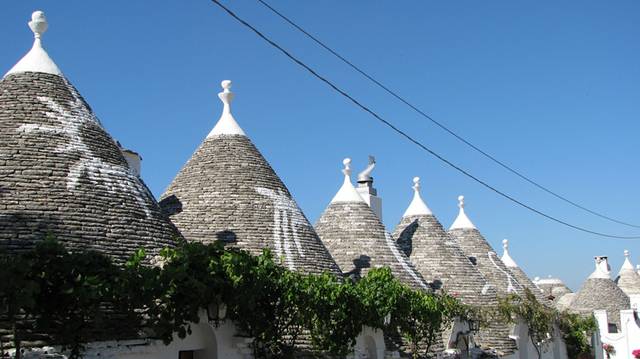
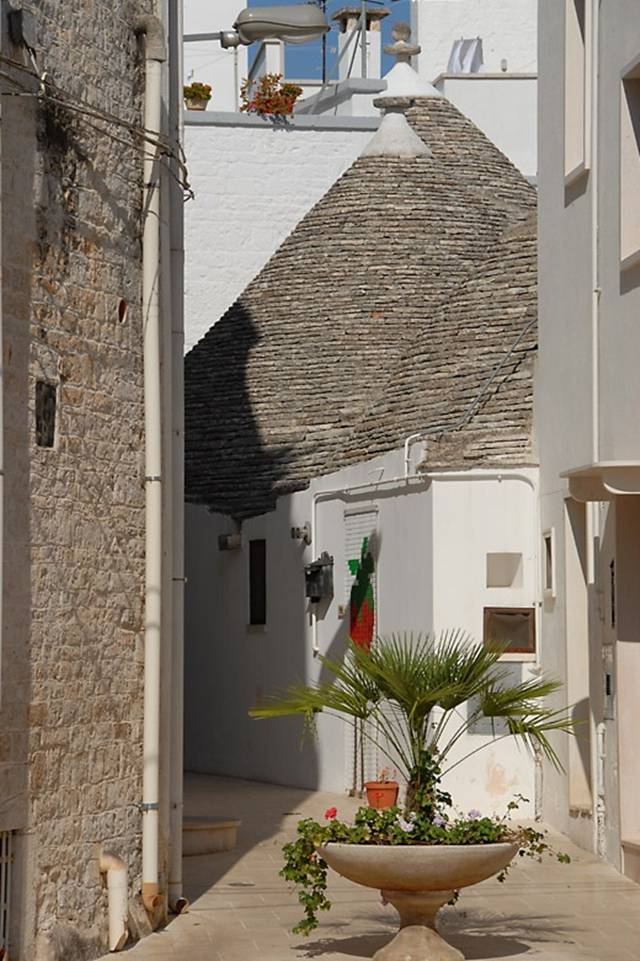
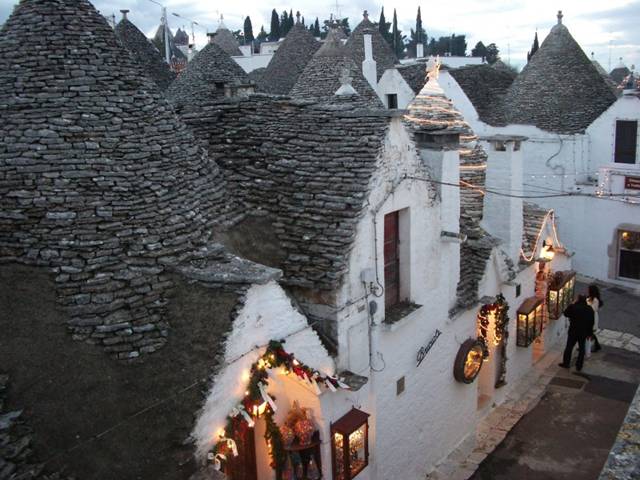
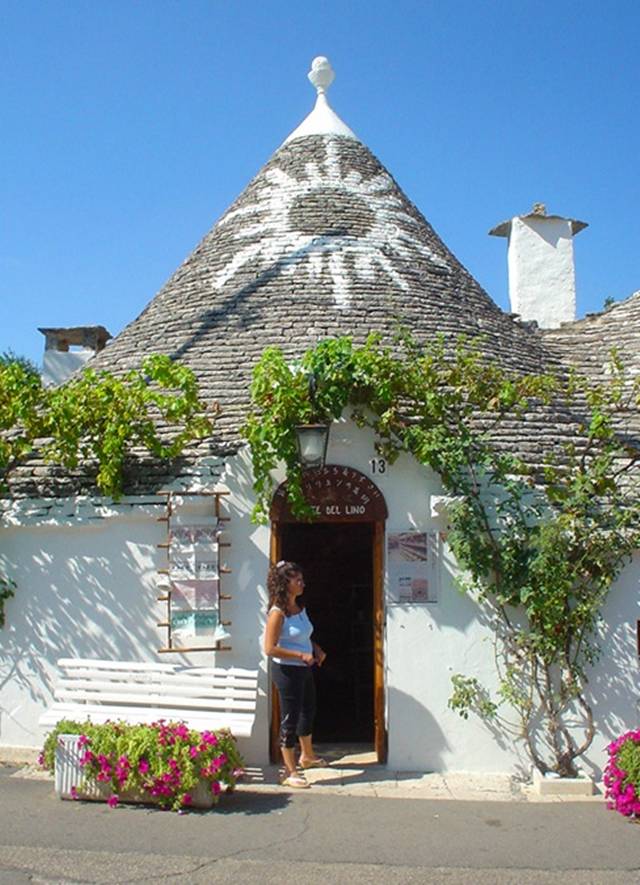
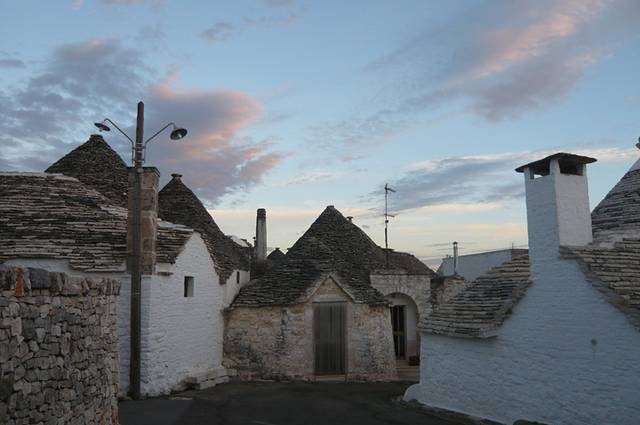
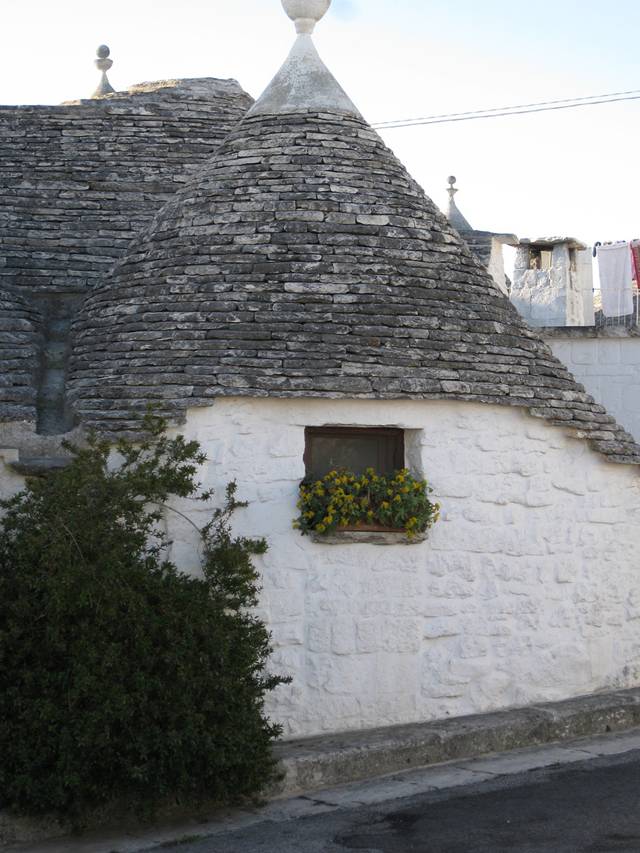
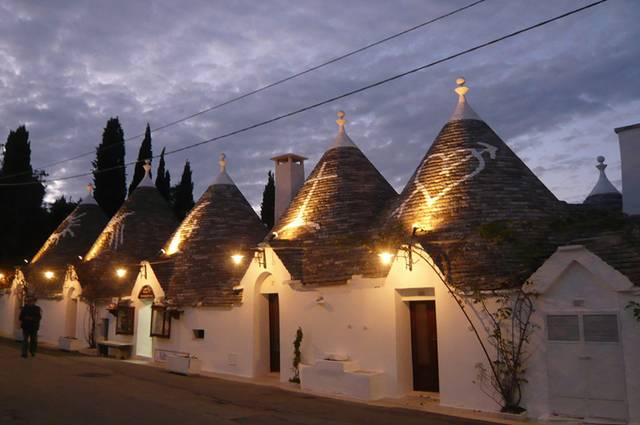
These buildings were constructed using roughly worked limestone boulders collected from neighbouring fields and, later, the large water-collecting basins in the area. They were built directly on the underlying natural rock, using exclusively the drystone technique. The walls that form the rectangular rooms are double, with rubble cores, and are pierced by small windows. Fireplaces, ovens and alcoves are recessed into the thickness of the walls. The roofs, which are also double-skinned, spring directly from the walls, simple squinches allowing the transition from the rectangular to the circular or oval sections of the roofs themselves. These are built up of successive courses of grey limestone slabs, known as chianche or chiancarelle . The roofs of the larger building terminate in a decorative pinnacle, often apotropaic in function. There are ingenious provisions for collecting rainwater using projecting eaves at the base of the roof which divert the water through a channelled slab into the cistern beneath the house. Flights of narrow stone steps give access to the roofs.
The interiors are equipped with wooden fittings, such as door frames, barrel-vaulted niches, etc., and in some of the larger trulli there is a second storey formed from a wooden floor and reached by means of a wooden staircase. Stone fireplaces and ovens are ventilated through stone slabs covering them. The roofs are not painted and develop a patina of mosses and lichens; they sometimes bear mythological or religious symbols in white ash. By contrast, the walls of the trulli must be whitewashed at regular intervals, which has the effect of rounding the outlines of the stones, giving a brilliant homogeneous surface. The Monti quarter, which covers 6 ha on a hillside, contains 1,030 trulli . Its streets run downhill and converge at the base of the hill. The Aja Piccola quarter, with 590 trulli , is less homogeneous than Monti. The streets converge on a common farmyard where in feudal times the peasants were forced to thresh wheat.
Alberobello, the city of drystone dwellings known as trulli , is an exceptional example of vernacular architecture. It is one of the best preserved and most homogeneous urban areas of this type in Europe. Its special features, and the fact that the buildings are still occupied, make it unique. It also represents a remarkable survival of prehistoric building techniques.

Manhattan of the Desert Shibam — Yemen

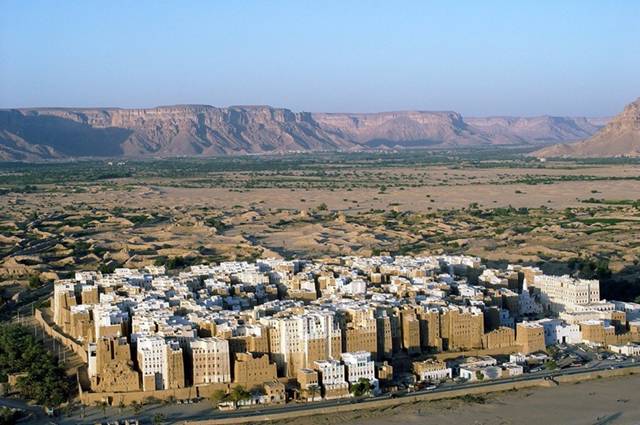
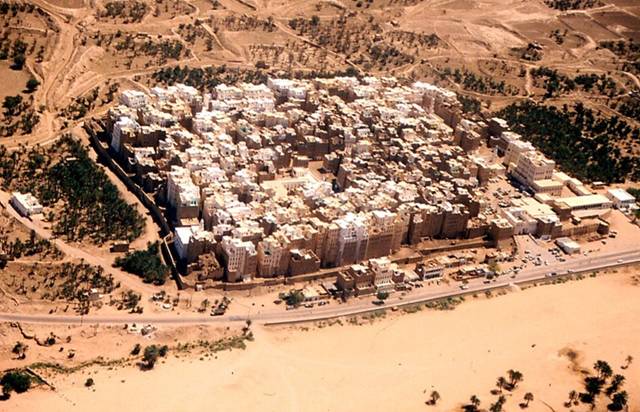
The city of Shibam, located in the central-western area of Hadhramaut Governorate, in the Ramlat al-Sab`atayn desert, is best known for its towering mudbrick skyscrapers. This small town of 7000 is packed with around 500 mud houses standing between 5 and 11 stories tall and reaching 100 feet high, all constructed entirely of mud bricks. The bizarre skyline that the high rise buildings bestow upon the city has earned Shibam the moniker "Manhattan of the Desert."

Shibam is often called "the oldest skyscraper city in the world" and is one of the oldest and best examples of urban planning based on the principle of vertical construction. Its plan is trapezoidal, almost rectangular; and it is enclosed by earthen walls within which a block of dwellings, also built from earth, have been laid out on an orthogonal grid. Shibam was founded in the 3rd century AD, but most of the houses you see here dates only to the 16th century, following a devastating flood of which Shibam was the victim in 1532-33. However, some older houses and large buildings still remain from the first centuries of Islam, such as the Friday Mosque, built in 904, and the castle, built in 1220.
The city of Shibam, located in the central-western area of Hadhramaut Governorate, in the Ramlat al-Sab`atayn desert, is best known for its towering mudbrick skyscrapers. This small town of 7000 is packed with around 500 mud houses standing between 5 and 11 stories tall and reaching 100 feet high, all constructed entirely of mud bricks. The bizarre skyline that the high rise buildings bestow upon the city has earned Shibam the moniker "Manhattan of the Desert."

In general the windowless lower floors are used for grain storage, with areas for domestic use above and those for family and leisure above that. The main room on the second floor is used by men for socializing. It often has wonderful carved plasterwork and freestanding decorated wooden columns supporting the ceiling, while women's areas are found higher, usually on the third or fourth floor. The highest rooms are for communal use by the whole family, and on the upper levels there are often bridges and doors connecting the houses. These are a defensive feature, but also a practical one – especially for old people who find it difficult to walk up and down the interminable staircases
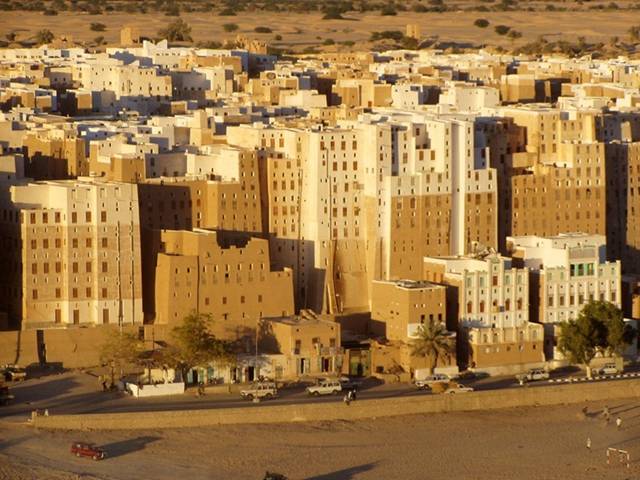
The houses needed to be rebuilt over the centuries. Rain and erosion have been constant threats to the buildings here. To protect their homes, residents must thickly coat the facades and roofs with sealant, and ensure they are maintained and regularly renovated. Those who can afford it limewash their houses to protect them against termites. Shibam was added to UNESCO's World Heritage list in 1982.
The city of Shibam, located in the central-western area of Hadhramaut Governorate, in the Ramlat al-Sab`atayn desert, is best known for its towering mudbrick skyscrapers. This small town of 7000 is packed with around 500 mud houses standing between 5 and 11 stories tall and reaching 100 feet high, all constructed entirely of mud bricks. The bizarre skyline that the high rise buildings bestow upon the city has earned Shibam the moniker "Manhattan of the Desert."The city of Shibam, located in the central-western area of Hadhramaut Governorate, in the Ramlat al-Sab`atayn desert, is best known for its towering mudbrick skyscrapers. This small town of 7000 is packed with around 500 mud houses standing between 5 and 11 stories tall and reaching 100 feet high, all constructed entirely of mud bricks. The bizarre skyline that the high rise buildings bestow upon the city has earned Shibam the moniker "Manhattan of the Desert."The city of Shibam, located in the central-western area of Hadhramaut Governorate, in the Ramlat al-Sab`atayn desert, is best known for its towering mudbrick skyscrapers. This small town of 7000 is packed with around 500 mud houses standing between 5 and 11 stories tall and reaching 100 feet high, all constructed entirely of mud bricks. The bizarre skyline that the high rise buildings bestow upon the city has earned Shibam the moniker "Manhattan of the Desert."The city of Shibam, located in the central-western area of Hadhramaut Governorate, in the Ramlat al-Sab`atayn desert, is best known for its towering mudbrick skyscrapers. This small town of 7000 is packed with around 500 mud houses standing between 5 and 11 stories tall and reaching 100 feet high, all constructed entirely of mud bricks. The bizarre skyline that the high rise buildings bestow upon the city has earned Shibam the moniker "Manhattan of the Desert."The city of Shibam, located in the central-western area of Hadhramaut Governorate, in the Ramlat al-Sab`atayn desert, is best known for its towering mudbrick skyscrapers. This small town of 7000 is packed with around 500 mud houses standing between 5 and 11 stories tall and reaching 100 feet high, all constructed entirely of mud bricks. The bizarre skyline that the high rise buildings bestow upon the city has earned Shibam the moniker "Manhattan of the Desert."The city of Shibam, located in the central-western area of Hadhramaut Governorate, in the Ramlat al-Sab`atayn desert, is best known for its towering mudbrick skyscrapers. This small town of 7000 is packed with around 500 mud houses standing between 5 and 11 stories tall and reaching 100 feet high, all constructed entirely of mud bricks. The bizarre skyline that the high rise buildings bestow upon the city has earned Shibam the moniker "Manhattan of the Desert."The city of Shibam, located in the central-western area of Hadhramaut Governorate, in the Ramlat al-Sab`atayn desert, is best known for its towering mudbrick skyscrapers. This small town of 7000 is packed with around 500 mud houses standing between 5 and 11 stories tall and reaching 100 feet high, all constructed entirely of mud bricks. The bizarre skyline that the high rise buildings bestow upon the city has earned Shibam the moniker "Manhattan of the Desert."The city of Shibam, located in the central-western area of Hadhramaut Governorate, in the Ramlat al-Sab`atayn desert, is best known for its towering mudbrick skyscrapers. This small town of 7000 is packed with around 500 mud houses standing between 5 and 11 stories tall and reaching 100 feet high, all constructed entirely of mud bricks. The bizarre skyline that the high rise buildings bestow upon the city has earned Shibam the moniker "Manhattan of the Desert."
 
Support : Venus Net | Pagak City
Copyright © 2013. teen pussy girl - All Rights Reserved
Template Created by Together Published by Venus Net
Proudly powered by Blogger