Recent Gallery


Tampilkan postingan dengan label Amazing Animals. Tampilkan semua postingan

Top 10 Dangerous Dog Breeds in the World

There are thousands of Dog bite cases all over the world,specially in Developing countries where Dogs can be found on Streets,it’s not that that the Street Dogs are responsible for all the cases,obviously sometimes Pet Dog are also responsible for these cases,However some of the Dog breeds are aggressive since the birth it is most probably because of the genes However training and proper care of any Dog can have impact on dog which is found in every Pet Dog,But still some of them are dangerous and have been found in lots of surveys on Dogs,Here we are listing top 10 dangerous Dog breeds-
1.PitBull-The Pitbull Dog breed comprises of different dog breeds namely-American Pit Bull Terrier, the American Staffordshire Terrier, the Staffordshire Terrier and any crosses between the three dog breeds.The Pitbull Dogs are also used in lots of illegal Dog Fighting in USA.

Pit Bull breeds have become famous for their roles as soldiers in the army by helping the Human soldiers,as police dogs, and as search and rescue dogs, actors, television personalities, seeing eye dogs and celebrity pets.

A pit bull is a fearless dog that will take on any opponent. They will lock their jaws onto the prey until it’s dead.
pitbull

2.Rottweilers-Rottweiler Dogs are from medium to large size breed of domestic dog that originated in Rottweil, Germany,The dogs were known as “Rottweil butchers’ dogs” because they were used to herd livestock and pull carts laden with butchered meat and other products to market.

Rottweilers Dogs are now used as search and rescue dogs, as guide dogs for the blind, as guard dogs or police dogs.

They are an extremely intelligent breed That’s why they make great guard dogs, but poor training can lead them to become very aggressive and disobedient.

Pitbull and Rottweiler are are responsible for an estimated 60 percent of all dog bite fatalities.
3.Siberian Husky-Siberian Husky is a medium-size, dense-coat working dog breed that originated in north-eastern Siberia. The breed belongs to the Spitz genetic family,Huskies are active, energetic, and resilient breed, Siberian Huskies were bred by the Chukchi of Northeastern Asia to pull heavy loads long distances through difficult conditions,Because they were originally bred for work and typically did not socialize with humans, this large breed can have behavioral issues and sometimes mistaken children for prey.
4.Alaskan Malamutes-Alaskan Malamute is a generally large breed of domestic dog . They are sometimes mistaken for a Siberian Husky due to color and markings, but they are quite different in many ways including size, structure and personality. As pets, once mature, Alaskan Malamutes have a very quiet, dignified temperament and are loyal to their owners.
5.German Shepherd-The German Shepherd Dog , also known as Alsatian or just the German Shepherd, is a breed of large-sized dog . German Shepherd is a relatively new breed of dog, with its origin dating to 1899. As part of the Herding Group, the German Shepherd is a working dog developed originally for herding and guarding sheep. Because of its strength, intelligence and abilities in obedience training it is widely used by police and military,German shepherds are very intelligent and friendly. But their jaw strength and natural instincts make them equally dangerous in certain situations.
6.Great Dane-The Great Dane, also known as German Mastiff or Danish Hound, is a breed of domestic dog known for its giant size.The Great Dane is one of the world’s tallest dog breeds,but they are also known for developing aggressive behavior with poor training. At 150 lbs with inches-long teeth, an aggressive dog presents a very dangerous scenario, especially around children.
7.Doberman Pinscher-Doberman Pinscher or simply called as Doberman, is a breed of domestic dog originally developed around 1890 by Karl Friedrich Louis Dobermann. Doberman Pinschers are one of the most common Dog Breed, and the breed is well known as an intelligent, alert, and loyal companion dog. They are known for responding aggressively to physical corrections in training,Therefore they can be dangerous.
8.Chow Chow- Chows are extremely territorial. Any strangers entering the property or approaching family members are considered a threat by this breed, and even well-trained dogs are known to aggressively defend their territory.,Sometimes can be too much dangerous.
9.Presa Canario-The Perro de Presa Canario is a large Molosser-type dog breed originally bred for working livestock. The name of the breed is Spanish, means “Canarian blood hound,” and is often shortened to “Presa Canario” or simply “Presa.”

Originally bred to guard and fight with cattle, an attack by this dog has been described as hopeless for the victim. They are a guardian breed with man-stopping ability, incredible power and a complete lack of fear.
10.Boxer-Boxer is a breed of stocky, medium-sized, short-haired dog. The coat is smooth and tight-fitting; colors are fawn or brindled, with or without white markings, which may cover the entire body.Boxers are the seventh most popular breed of dog in the United States.These dogs are not typically aggressive by nature. They are bright, energetic and playful breed. Boxers have been known to be “headstrong”, which makes it a bit difficult to train them but with positive reinforcement techniques, Boxers often respond much better.

Official World’s Largest Croc in the Philippines

The Guinness Book of World Records has declared a saltwater crocodile the largest such reptile in captivity in the Philippines. The huge beast weighs more than a tonne, measures 6.17-metre (20.24-foot) and it is suspected of killing two people.
aligatorThe male crocodile, nicknamed “Lolong”, had been sought for the last two years after a killing of a girl and the disappearance of a fisherman. He was captured in the Agusan marsh on the southern island of Mindanao last September.
Guinness stated on its website: “The largest crocodile in captivity is Lolong, a saltwater crocodile (Crocodylus porosus), who measured 6.17 m. Lolong’s weight was also measured at a nearby truck weigh-bridge and verified as approximately 1,075 kg (2,370 lbs).”

The local Government have received a certificate from Guinness; the croc is currently in the custody of the town of Bunawan. The media affairs co-ordinator, Welinda Asis Elorde, said: “He’s doing well. I think he has already adapted to his new environment.”
Lolong has been put on a diet, he was being fed the equivalent of 10 per cent of his body weight in high protein meats such as beef, pork and poultry every month, but that has now been reduced to eight to 10 kilograms a week so he can become more active.
The previous record holder was a 5.48-metre Australian saltwater crocodile called Cassius who weighs nearly a tonne; he is kept at a crocodile park at an island off Queensland and has been there since he was captured in 1984.
According to media affairs co-ordinator, Welinda Asis Elorde Lolong is still a ‘big tourist attraction’ with hundreds of people visiting daily.

The Heart of the Whale

The Heart of the Whale, which was brought to a veterinary school for research.

World's Ugliest dog

World's Ugliest dog

World's Biggest Dog

World's Biggest Dog

Unusual Mummified Animals (5 pics)

The ancient Egyptians mummified animals as well as humans.
Animals of all kinds were important to the Ancient Egyptians, and
featured in the daily secular and religious lives of farmers, craftsmen,
priests and rulers. Animals were reared mainly for food, whilst others
were kept as pets. The bodies of sacred animals and some pets were
often mummified and given elaborate burials.
Unusual mummies of animalsA queen’s pet gazelle was readied for eternity with the same lavish care
as a member of the royal family. In fine, blue-trimmed bandages and a
custom-made wooden coffin, it accompanied its owner to the grave in
about 945 B.C. Egyptian Museum, Cairo
Unusual mummies of animals
Lovingly preserved, a hunting dog whose bandages fell off long ago
likely belonged to a pharaoh. As a royal pet, it “would have been fed
nibbly bits and spoiled rotten,” says Salima Ikram. When it died, it was
interred in a specially prepared tomb in the Valley of the Kings.

Unusual mummies of animals
A raptor with an appliquéd face holds only a few bones.

Unusual mummies of animals Votive mummies, each buried with a prayer, are infinitely varied but
not always what they seem. A cunning crocodile is a fake—it has
nothing inside.

Unusual mummies of animals
Baboon harbors a secret that helps identify it as a pet: An x-ray
revealed missing canine teeth, probably removed to keep the creature
from nipping royal fingers.

The Weird Sport of Goose Pulling

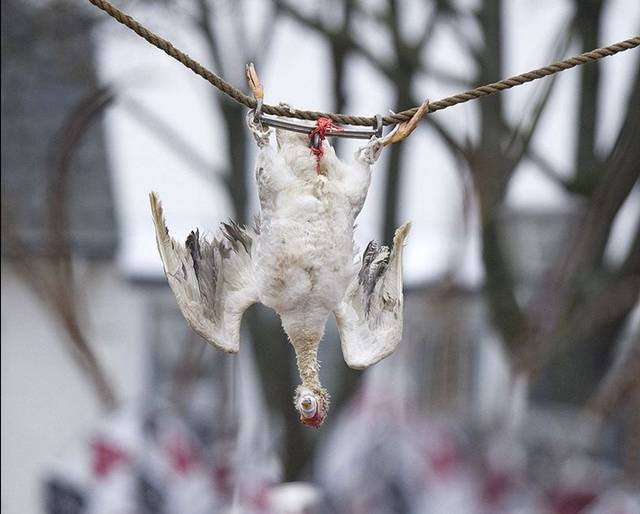
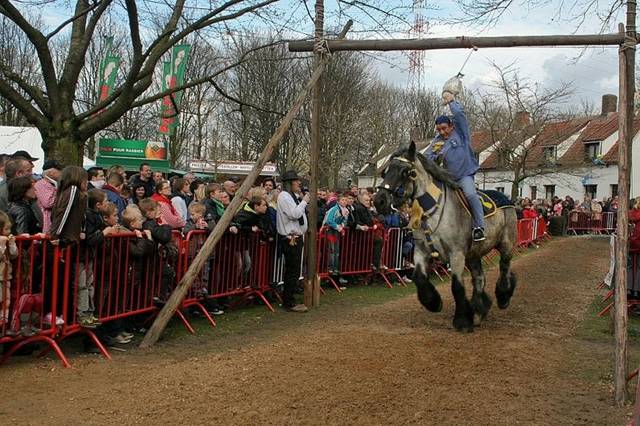
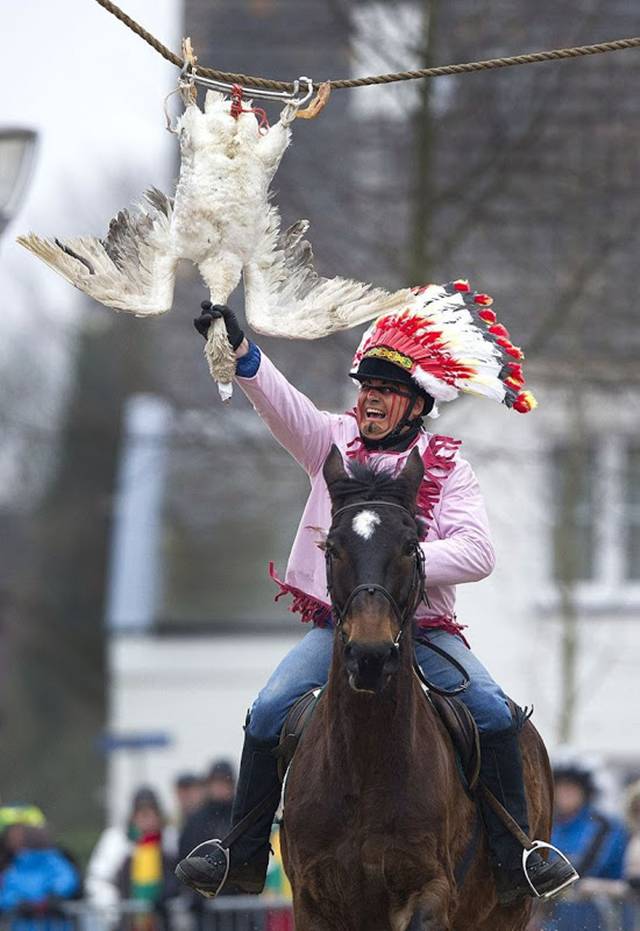
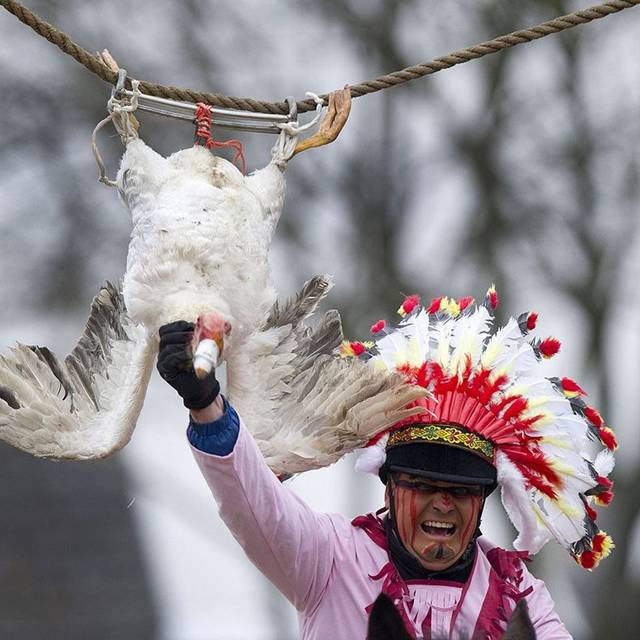
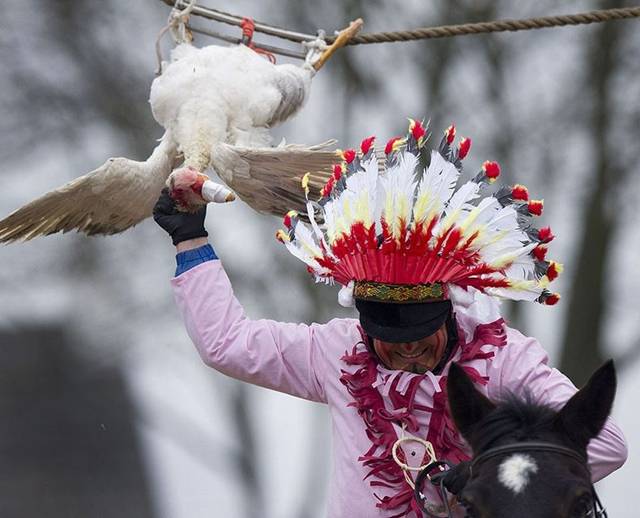
Goose pulling is an old sport originally played in parts of the Netherlands, Belgium, England and North America from the 17th to the 19th centuries. The sport involves a goose that is hung by its legs from a pole or rope that is stretched across a road. A man riding on horseback at a full gallop would attempt to grab the bird by the neck in order to pull the head off. Whoever makes off with the head is declared winner and becomes the noble hero of the day. Goose pulling is still practiced today, in parts of Belgium and in Grevenbicht in the Netherlands as part of Shrove Tuesday and in some towns in Germany as part of the Shrove Monday celebrations.

During the old days a live goose was used. To make the sport challenging, the goose's neck was generously oiled to make it difficult to retain a grip on it, and the bird's constant fluttering and flailing made it difficult to target it in the first place. Sometimes "a nigger” with a long whip in hand was stationed near the target who would harass the horse as he passed by.
Goose pulling is an old sport originally played in parts of the Netherlands, Belgium, England and North America from the 17th to the 19th centuries. The sport involves a goose that is hung by its legs from a pole or rope that is stretched across a road. A man riding on horseback at a full gallop would attempt to grab the bird by the neck in order to pull the head off. Whoever makes off with the head is declared winner and becomes the noble hero of the day. Goose pulling is still practiced today, in parts of Belgium and in Grevenbicht in the Netherlands as part of Shrove Tuesday and in some towns in Germany as part of the Shrove Monday celebrations.
The prizes of a goose-pulling contest were trivial – often the dead bird itself, other times contributions from the audience or rounds of drinks. The main draw of such contests for the spectators was the betting on the competitors, sometimes for money or more often for alcoholic drinks.

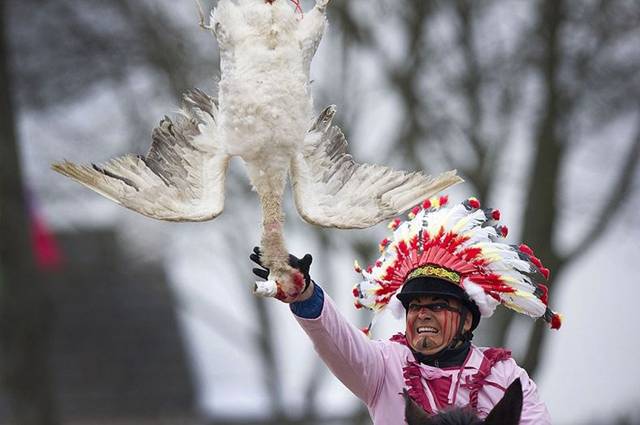
Today, instead of live geese, dead ones are used, but that doesn’t make the sport any less brutal. Even during the old days when animal brutality were common, goose pulling was often frowned upon and sometimes compared to the barbarous practice of bull-fighting.

Goose pulling largely died out in the United States after the Civil War, though it was still occasionally practiced in parts of the South as late as the 1870s. However, in Grevenbicht in the Netherlands and in parts of Belgium and Germany, goose pulling – using a dead goose that has been humanely killed by a veterinarian – continues to this day as part of traditional Shrove Tuesday celebrations. It is referred to as Ganstrekken in the Netherlands, Gansrijden in Belgium and Gänsereiten in Germany. Although the use of live geese was banned in the 1920s, the practice still arouses some controversy. In 2008 the Dutch Party for Animals (PvdD) proposed that it should be banned. The organizers rejected the proposal, pointing out that there was no question of cruelty to animals because the geese were already dead.

Belgian goose pulling is accompanied by an elaborate set of customs. The rider who succeeds in pulling off the goose's head is "crowned" as the "king" for one year and given a crown and mantle. At the end of his "king year" the ruling king has to treat his "subjects" to a feast of beer, drinks, cigars and bread pudding or sausages held either at his home or at a local pub. The kings compete with each other to become the "emperor".
Goose pulling is an old sport originally played in parts of the Netherlands, Belgium, England and North America from the 17th to the 19th centuries. The sport involves a goose that is hung by its legs from a pole or rope that is stretched across a road. A man riding on horseback at a full gallop would attempt to grab the bird by the neck in order to pull the head off. Whoever makes off with the head is declared winner and becomes the noble hero of the day. Goose pulling is still practiced today, in parts of Belgium and in Grevenbicht in the Netherlands as part of Shrove Tuesday and in some towns in Germany as part of the Shrove Monday celebrations.
Goose pulling in 19th-century West Virginia
Goose pulling is an old sport originally played in parts of the Netherlands, Belgium, England and North America from the 17th to the 19th centuries. The sport involves a goose that is hung by its legs from a pole or rope that is stretched across a road. A man riding on horseback at a full gallop would attempt to grab the bird by the neck in order to pull the head off. Whoever makes off with the head is declared winner and becomes the noble hero of the day. Goose pulling is still practiced today, in parts of Belgium and in Grevenbicht in the Netherlands as part of Shrove Tuesday and in some towns in Germany as part of the Shrove Monday celebrations.
 Photo — Link
Goose pulling in Belgium.

Goose pulling is an old sport originally played in parts of the Netherlands, Belgium, England and North America from the 17th to the 19th centuries. The sport involves a goose that is hung by its legs from a pole or rope that is stretched across a road. A man riding on horseback at a full gallop would attempt to grab the bird by the neck in order to pull the head off. Whoever makes off with the head is declared winner and becomes the noble hero of the day. Goose pulling is still practiced today, in parts of Belgium and in Grevenbicht in the Netherlands as part of Shrove Tuesday and in some towns in Germany as part of the Shrove Monday celebrations.
 Photo — Link

Goose pulling in Antwerp, Belgium.
Goose pulling is an old sport originally played in parts of the Netherlands, Belgium, England and North America from the 17th to the 19th centuries. The sport involves a goose that is hung by its legs from a pole or rope that is stretched across a road. A man riding on horseback at a full gallop would attempt to grab the bird by the neck in order to pull the head off. Whoever makes off with the head is declared winner and becomes the noble hero of the day. Goose pulling is still practiced today, in parts of Belgium and in Grevenbicht in the Netherlands as part of Shrove Tuesday and in some towns in Germany as part of the Shrove Monday celebrations.
Goose pulling in Grevenbicht, the Netherland.
Goose pulling is an old sport originally played in parts of the Netherlands, Belgium, England and North America from the 17th to the 19th centuries. The sport involves a goose that is hung by its legs from a pole or rope that is stretched across a road. A man riding on horseback at a full gallop would attempt to grab the bird by the neck in order to pull the head off. Whoever makes off with the head is declared winner and becomes the noble hero of the day. Goose pulling is still practiced today, in parts of Belgium and in Grevenbicht in the Netherlands as part of Shrove Tuesday and in some towns in Germany as part of the Shrove Monday celebrations.

Link — 1 2

Bird Nest Hanging on a Telephone Pole

The Lorax than what you would find in Africa's Kalahari Desert, these fantastically decorated telephone poles are actually home to the aptly named Sociable Weaver bird.  The communist little soarers don't just build massive homes for their own kind—they even allow other species of birds to settle down in the nests, which could very well hold up to 100 birds at a time. According to the San Diego Zoo, the South African pygmy falcon Polihierax semitorquatus (otherwise known in layman's terms as good-for-nothing squatters) "relies completely on the sociable weavers' nest for its own home, often nesting side by side with the sociable weavers.

Looking more like something out of The Lorax than what you would find in Africa's Kalahari Desert, these fantastically decorated telephone poles are actually home to the aptly named Sociable Weaver bird.

The communist little soarers don't just build massive homes for their own kind—they even allow other species of birds to settle down in the nests, which could very well hold up to 100 birds at a time. According to the San Diego Zoo, the South African pygmy falcon Polihierax semitorquatus (otherwise known in layman's terms as good-for-nothing squatters) "relies completely on the sociable weavers' nest for its own home, often nesting side by side with the sociable weavers."

The Lorax than what you would find in Africa's Kalahari Desert, these fantastically decorated telephone poles are actually home to the aptly named Sociable Weaver bird.  The communist little soarers don't just build massive homes for their own kind—they even allow other species of birds to settle down in the nests, which could very well hold up to 100 birds at a time. According to the San Diego Zoo, the South African pygmy falcon Polihierax semitorquatus (otherwise known in layman's terms as good-for-nothing squatters) "relies completely on the sociable weavers' nest for its own home, often nesting side by side with the sociable weavers.

Photographer Dillon Marsh has an entire series on these whimsical bird colonies called Assimilation. A few of the nests even look big enough for a human to crawl into, although its hard to imagine we'd be greeted with quite the same open wings as their feathered brethren. 

The Lorax than what you would find in Africa's Kalahari Desert, these fantastically decorated telephone poles are actually home to the aptly named Sociable Weaver bird.  The communist little soarers don't just build massive homes for their own kind—they even allow other species of birds to settle down in the nests, which could very well hold up to 100 birds at a time. According to the San Diego Zoo, the South African pygmy falcon Polihierax semitorquatus (otherwise known in layman's terms as good-for-nothing squatters) "relies completely on the sociable weavers' nest for its own home, often nesting side by side with the sociable weavers.

The Lorax than what you would find in Africa's Kalahari Desert, these fantastically decorated telephone poles are actually home to the aptly named Sociable Weaver bird.  The communist little soarers don't just build massive homes for their own kind—they even allow other species of birds to settle down in the nests, which could very well hold up to 100 birds at a time. According to the San Diego Zoo, the South African pygmy falcon Polihierax semitorquatus (otherwise known in layman's terms as good-for-nothing squatters) "relies completely on the sociable weavers' nest for its own home, often nesting side by side with the sociable weavers.

The Lorax than what you would find in Africa's Kalahari Desert, these fantastically decorated telephone poles are actually home to the aptly named Sociable Weaver bird.  The communist little soarers don't just build massive homes for their own kind—they even allow other species of birds to settle down in the nests, which could very well hold up to 100 birds at a time. According to the San Diego Zoo, the South African pygmy falcon Polihierax semitorquatus (otherwise known in layman's terms as good-for-nothing squatters) "relies completely on the sociable weavers' nest for its own home, often nesting side by side with the sociable weavers.

The Lorax than what you would find in Africa's Kalahari Desert, these fantastically decorated telephone poles are actually home to the aptly named Sociable Weaver bird.  The communist little soarers don't just build massive homes for their own kind—they even allow other species of birds to settle down in the nests, which could very well hold up to 100 birds at a time. According to the San Diego Zoo, the South African pygmy falcon Polihierax semitorquatus (otherwise known in layman's terms as good-for-nothing squatters) "relies completely on the sociable weavers' nest for its own home, often nesting side by side with the sociable weavers.

The Lorax than what you would find in Africa's Kalahari Desert, these fantastically decorated telephone poles are actually home to the aptly named Sociable Weaver bird.  The communist little soarers don't just build massive homes for their own kind—they even allow other species of birds to settle down in the nests, which could very well hold up to 100 birds at a time. According to the San Diego Zoo, the South African pygmy falcon Polihierax semitorquatus (otherwise known in layman's terms as good-for-nothing squatters) "relies completely on the sociable weavers' nest for its own home, often nesting side by side with the sociable weavers.

The Lorax than what you would find in Africa's Kalahari Desert, these fantastically decorated telephone poles are actually home to the aptly named Sociable Weaver bird.  The communist little soarers don't just build massive homes for their own kind—they even allow other species of birds to settle down in the nests, which could very well hold up to 100 birds at a time. According to the San Diego Zoo, the South African pygmy falcon Polihierax semitorquatus (otherwise known in layman's terms as good-for-nothing squatters) "relies completely on the sociable weavers' nest for its own home, often nesting side by side with the sociable weavers.

The Lorax than what you would find in Africa's Kalahari Desert, these fantastically decorated telephone poles are actually home to the aptly named Sociable Weaver bird.  The communist little soarers don't just build massive homes for their own kind—they even allow other species of birds to settle down in the nests, which could very well hold up to 100 birds at a time. According to the San Diego Zoo, the South African pygmy falcon Polihierax semitorquatus (otherwise known in layman's terms as good-for-nothing squatters) "relies completely on the sociable weavers' nest for its own home, often nesting side by side with the sociable weavers.

The Lorax than what you would find in Africa's Kalahari Desert, these fantastically decorated telephone poles are actually home to the aptly named Sociable Weaver bird.  The communist little soarers don't just build massive homes for their own kind—they even allow other species of birds to settle down in the nests, which could very well hold up to 100 birds at a time. According to the San Diego Zoo, the South African pygmy falcon Polihierax semitorquatus (otherwise known in layman's terms as good-for-nothing squatters) "relies completely on the sociable weavers' nest for its own home, often nesting side by side with the sociable weavers.

The Lorax than what you would find in Africa's Kalahari Desert, these fantastically decorated telephone poles are actually home to the aptly named Sociable Weaver bird.  The communist little soarers don't just build massive homes for their own kind—they even allow other species of birds to settle down in the nests, which could very well hold up to 100 birds at a time. According to the San Diego Zoo, the South African pygmy falcon Polihierax semitorquatus (otherwise known in layman's terms as good-for-nothing squatters) "relies completely on the sociable weavers' nest for its own home, often nesting side by side with the sociable weavers.

The Lorax than what you would find in Africa's Kalahari Desert, these fantastically decorated telephone poles are actually home to the aptly named Sociable Weaver bird.  The communist little soarers don't just build massive homes for their own kind—they even allow other species of birds to settle down in the nests, which could very well hold up to 100 birds at a time. According to the San Diego Zoo, the South African pygmy falcon Polihierax semitorquatus (otherwise known in layman's terms as good-for-nothing squatters) "relies completely on the sociable weavers' nest for its own home, often nesting side by side with the sociable weavers.
 
Support : Venus Net | Pagak City
Copyright © 2013. teen pussy girl - All Rights Reserved
Template Created by Together Published by Venus Net
Proudly powered by Blogger